Fashion / News · Trends · Shopping · Style
Marni SS27 finds new energy in its familiar contradictions
Meryll Rogge sharpens the house’s eccentric vocabulary through exposed construction, changing scale and a more urban sense of character.
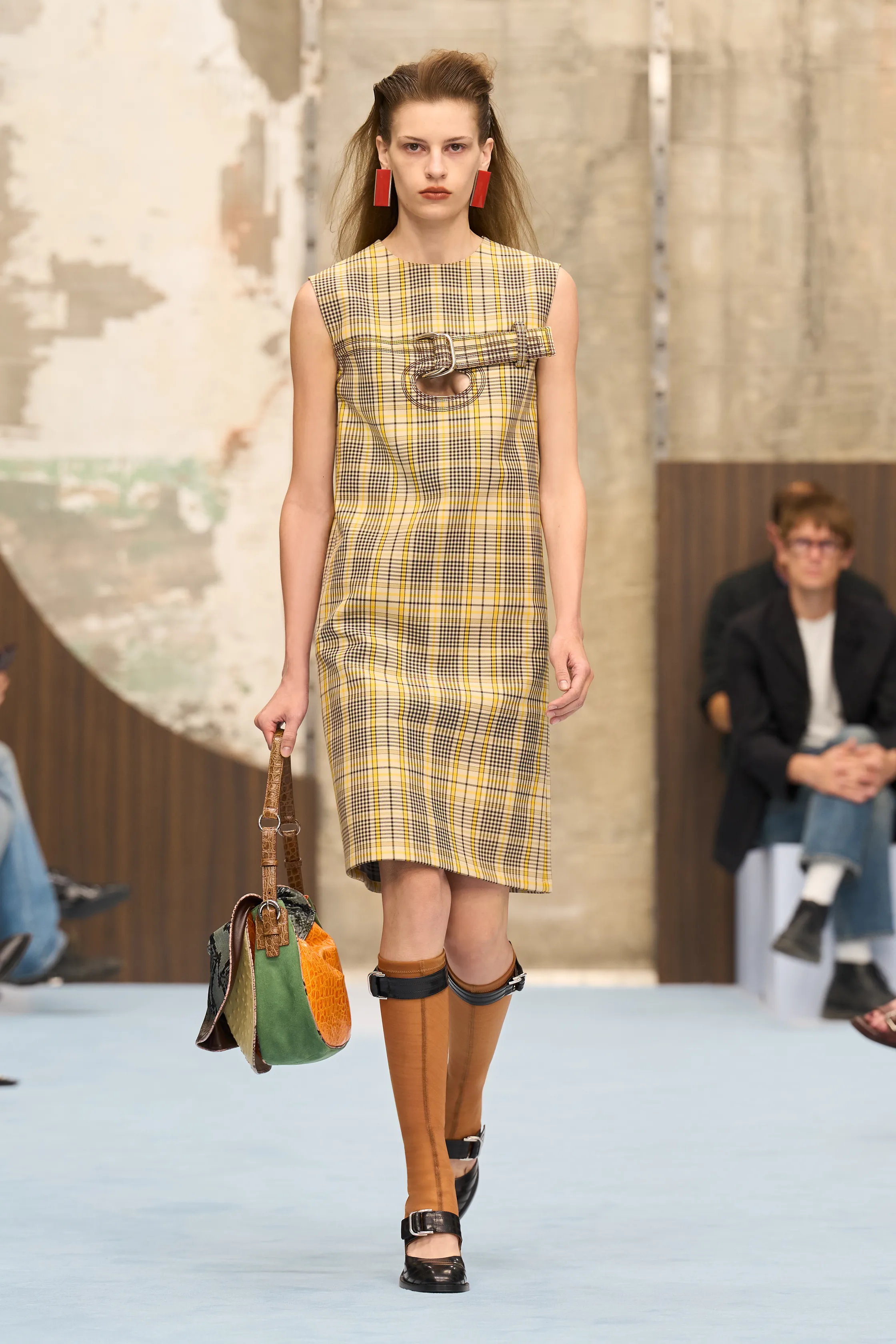
A new creative director is often expected to make a house look immediately different. At Marni, Meryll Rogge’s Spring/Summer 2027 collection suggested a more demanding task: deciding which qualities deserve to continue, and how to make them active again. Her second collection for the house, presented in Milan on 24 September 2026, worked with Marni’s familiar awkwardness and appetite for contradiction. The changes occurred through construction, proportion and the migration of details between garments, giving continuity a restless quality. [ That approach suits a brand whose appeal depends on individuality. A completely resolved, universally flattering wardrobe would miss much of what makes Marni interesting. The challenge is to let unfamiliar proportions and unexpected combinations feel chosen rather than accidental. For StraitsG readers, the collection opens a discussion about clothes that express taste without relying on conventional glamour or obvious status signals.
An archive used as material
Rogge’s reported approach treats the archive as something to edit, rearrange and test. The collection draws on past house codes without turning them into protected exhibits. That distinction matters. An archive can become a checklist of recognisable motifs, but it can also supply raw material for a current design problem. The second route gives a designer room to question the original relationship between a detail and its purpose.
Our reading is that continuity becomes more persuasive when it includes disagreement. A house does not remain alive simply because it reproduces familiar objects. It needs a recognisable method of looking at the world. Marni’s method permits wrongness, unusual colour relationships and proportions that do not immediately flatter. Rogge can work within that method while giving it a sharper present-day edge. The identity survives because its underlying curiosity survives, not because every earlier silhouette returns intact.
Scale changes the mood
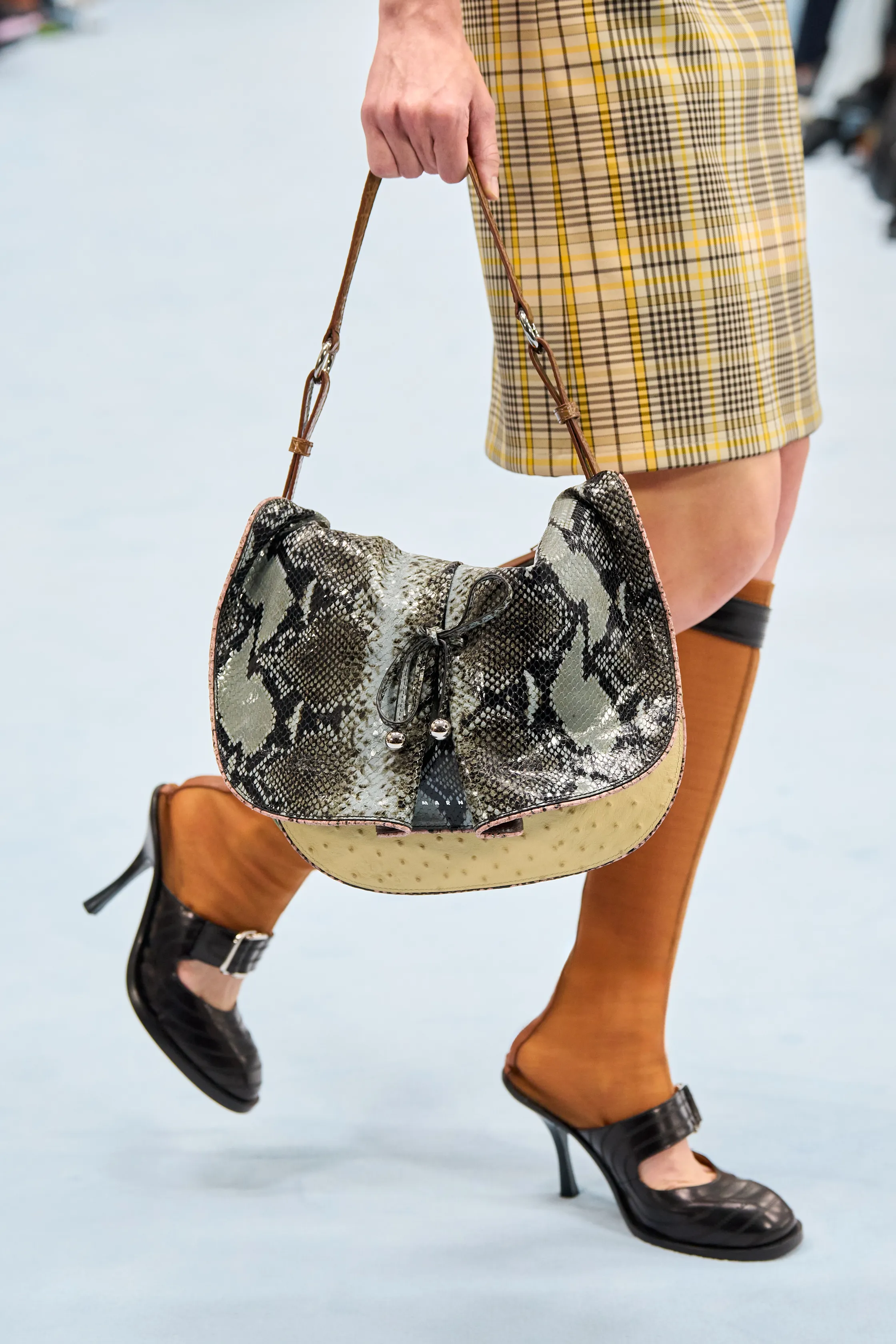
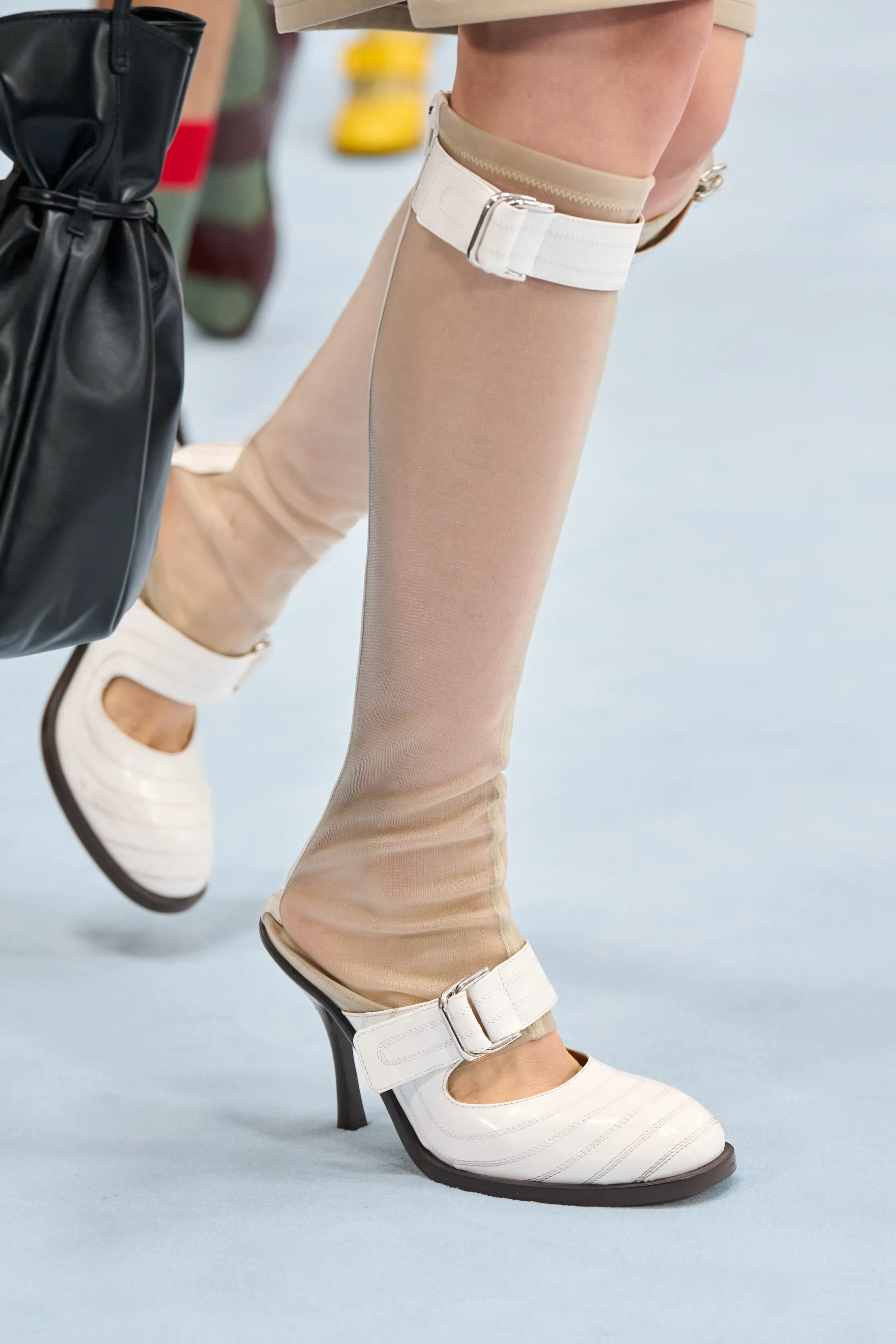
The collection’s reported details include enlarged and reduced hardware, exposed linings, visible triple stitching and a bra outline incorporated into a garment. These are changes to how clothing communicates its own construction. The eye is drawn to places it might usually overlook.
Scale is particularly effective because it alters an object without making it unrecognisable. A familiar button, belt or buckle can become strange when its proportions change. The viewer is asked to reconsider something usually understood without effort. This gives the clothes a dry humour. They can remain useful objects while making the conventions of usefulness visible. A detail that appears exaggerated does not necessarily improve function, but it can make the garment’s character more specific.
The appeal of an unsettled outfit
Many wardrobes are assembled around the idea that each element should agree with the others. Marni’s proposition allows disagreement to remain. A strict piece can sit beside something softer. A decorative surface can coexist with a workmanlike finish. The outfit becomes a composition of different intentions rather than a seamless mood.
There is a practical lesson here, although it should not be mistaken for a formula. One unexpected relationship can make familiar clothes look newly personal. Too many equally forceful decisions may cancel one another out. The wearer needs to establish where the eye should pause and where it can move more quietly. Marni’s eccentricity is most useful when it encourages that kind of active editing. It asks for judgment, not simply the purchase of an unusual object.
Construction as visual identity
Visible seams and displaced details direct attention to the garment as something made. This can give clothing an industrial register without making it anonymous. The distinction depends on the designer’s control: the exposed element has to contribute to the whole rather than resemble an unfinished task. Marni’s vocabulary accommodates these interruptions because its personality already resists smooth perfection.
For a digital audience, such details also reveal a limitation of runway images. A close-up may explain more about the design than a full-length photograph. An outfit that appears straightforward from a distance may contain its real argument in a seam or an opening. Conversely, a striking overall image can conceal a detail that does little beyond drawing attention. Looking at both scales allows a reader to judge whether the eccentricity is structurally meaningful or merely decorative.
A Singapore wardrobe with room for difference
Our local styling interpretation would give one Marni-like contradiction space to work. Pair an expressive skirt or dress with a quieter shoe. Let unusual hardware appear against a simple surface. If colour is the strongest decision, avoid making every accessory equally assertive. The intention is to allow individuality to register without turning an everyday outfit into a display of all its wearer’s interests at once.
Proportion can carry the idea even when fabrication changes. A person who prefers lighter clothes can experiment with the relationship between a compact upper half and a fuller lower half, or vice versa, using pieces already owned. The suitability of a particular runway garment for Singapore still requires checking composition, lining and fit. The collection provides a visual proposition, not a guarantee of comfort. Its transferable value lies in the confidence to leave an interesting mismatch unresolved.
The most useful test of an eccentric piece is whether its owner still likes it when the novelty becomes familiar. An unusual buckle or exposed construction may draw attention immediately, but repeated wearing reveals whether it continues to feel expressive. Does the detail help the outfit come together, or does it require constant explanation? Can the garment remain interesting with simpler companions? These are questions about longevity of interest, not claims about measurable durability or sales. They matter because individuality develops through repeated choices. A wardrobe full of objects selected only for their first impression may eventually feel less personal than one in which a smaller number of distinctive pieces become familiar companions. Marni’s language of contradiction offers that possibility when its oddness can settle into the owner’s routine without becoming visually inert or too demanding to use.
## Continuity that can keep moving
The design question extends beyond one season. If a house’s identity depends on eccentricity, repetition can eventually make that eccentricity predictable. Rogge’s approach has to keep familiar codes responsive enough to surprise. Changes of scale and visible construction are useful because they alter relationships rather than merely introduce another motif. They offer ways to continue a language without allowing it to settle into automatic recognition.
Marni SS27 makes that process feel like the subject of the collection. It invites the wearer to participate in a similarly selective exercise: what should be kept, what should be changed, and which apparent inconsistency is actually the most personal part of an outfit? For a Singapore fashion readership, that is a richer takeaway than a list of colours or accessories. The collection presents individuality as an ongoing act of composition, with enough friction to remain interesting and enough continuity to remain unmistakably Marni.
Gallery
3 images
About the author
Olivia Wang
Fashion editor and writer covering design, image-making and the creative networks connecting Southeast Asia.