Fashion / News · Trends · Shopping · Style
Hermès SS27 brings air into the luxury wardrobe
Nadège Vanhée gives summer dressing a modular character, using openings, adjustable construction and a brighter palette to make ease visible.

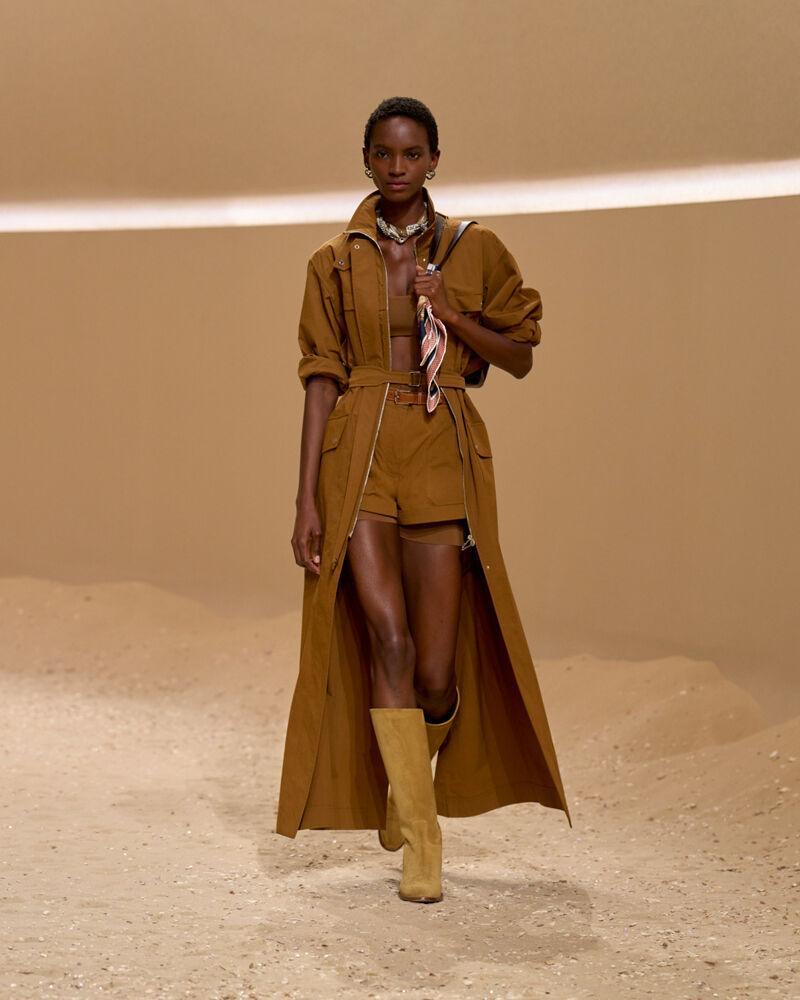
Hermès’s Spring/Summer 2027 womenswear collection treated air as both atmosphere and design material. Presented in Paris on 3 October 2026, Nadège Vanhée’s collection used openings, adjustable details and lighter-looking surfaces to reconsider the house’s relationship with the body. The official Hermès account describes a move between heritage references and modular, utilitarian silhouettes, with cords, zips and belts shaping volume. The proposition is restrained, yet it gives the wearer a more active role in determining how a garment appears.
For StraitsG’s Singapore audience, that role is particularly interesting. Summer clothing is useful when it can respond to changing conditions and preferences, rather than provide only one fixed image. The collection does not need to have been designed for Singapore to prompt a relevant discussion. It asks how refinement can coexist with adjustment, openness and the ordinary need to move comfortably through a day.
Air changes the design brief
Air can be represented through colour or atmosphere, but its more meaningful role in clothing concerns space and access. Openings alter the relationship between fabric and skin. A less enclosed construction can make the garment’s inner and outer worlds more visible to one another. The official collection language places sheer fabrics, perforations and silk mesh within that discussion.
Our interpretation is that the idea makes luxury less static. The garment is no longer understood only as a perfectly resolved surface. It can contain interruptions that contribute to use and visual character. That does not mean every opening provides effective cooling, or that appearance establishes comfort. It means the design makes room for a practical question inside its image of refinement: how much enclosure does the body need, and where can it be reduced?
Adjustment becomes part of the appearance
Runway reporting records dresses and trousers whose zips change length or silhouette, along with a parka separated at the waist and connected by snaps. These details give the wearer more than one version of an object. The construction is not only a hidden mechanism; it participates in how the garment is seen.
This is a valuable design direction when the alternatives are useful rather than merely demonstrative. An adjustable piece needs to work convincingly in more than one configuration. The closures should be manageable, the transitions comfortable and the changed proportions intentional. Otherwise, modularity risks becoming another feature whose novelty exceeds its use. The fitting room is the place to test that distinction, moving between versions and asking whether each one has a clear role in the owner’s life.
The palette loosens the mood
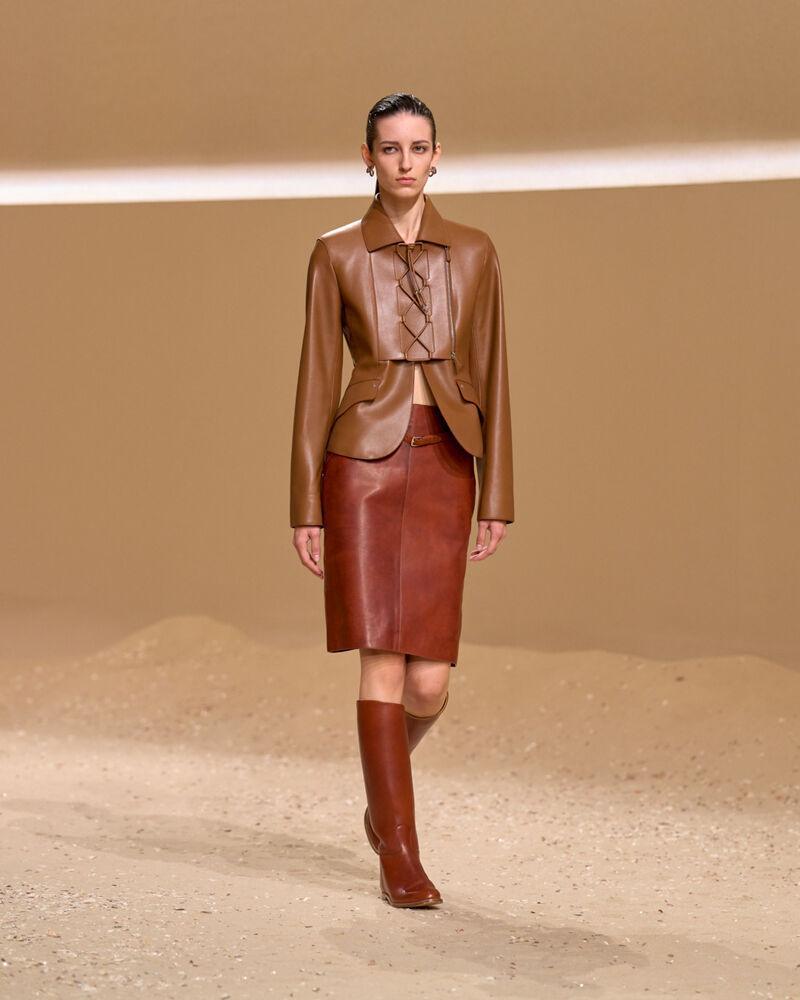
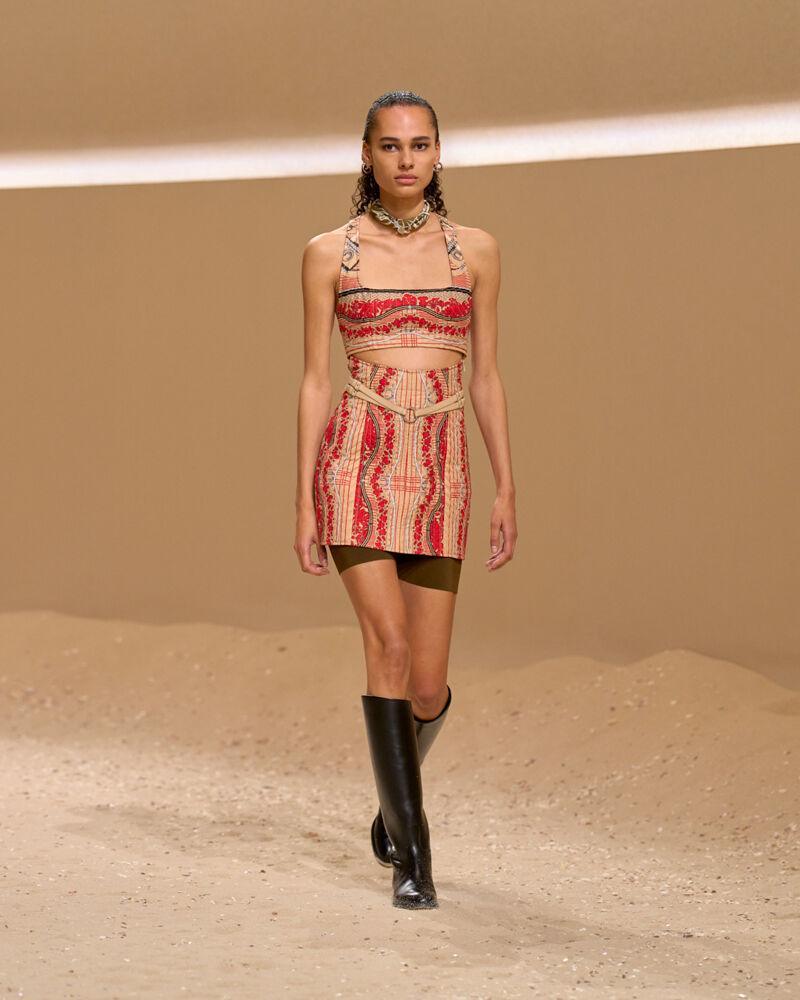
Contemporary coverage identifies creamy whites and more vivid yellow and orange, with leather often appearing as an accent rather than determining the whole look. Other accounts describe mesh knits, technical layers and tactile contrasts. These details give the collection a summer register without requiring it to discard Hermès’s material identity.
Colour can make restraint feel less severe. A clear, uncomplicated silhouette takes on another emotional temperature when the palette changes. The effect is particularly useful when the construction already supplies visual interest: the garment can remain calm in outline while becoming more open in mood. A wearer who prefers quieter tones can still take interest in the modular idea. Another may respond first to colour and use simpler combinations to give it space.
Tactility is an everyday experience
Luxury material discussions often concentrate on the rare or prestigious starting substance. A more useful assessment also asks how the finished object feels when handled and worn. A surface may be beautiful but need constant attention. A closure may look elegant but prove difficult to operate. A fabric may have a subtle texture that becomes more rewarding through repeated contact.
Our reading of this Hermès collection places those ordinary experiences near the centre. Adjustable construction requires a hand to act on the garment. The owner participates in its final form. That can create a closer relationship with the object, provided the mechanism feels natural enough to use. The value of making is therefore encountered through a routine action, rather than remaining something that only a specialist can identify from an isolated detail photograph.
Translating the proposal for Singapore
Our local edit would prioritise a flexible piece with a clear daily purpose. An adjustable silhouette may accommodate more than one occasion. A calm base can make a brighter garment feel integrated. A visually open surface can introduce another texture without requiring several heavy layers. The aim is to preserve the collection’s relationship between refinement and practical choice, rather than reproduce every runway accessory or combination.
The practical checks remain individual. A garment described as feathery may still have lining, trims or areas of dense construction. A beautiful leather accent can alter how a piece feels at the waist or shoulder. In Singapore, movement, fabric composition and the amount of contact with the body matter more than the collection’s seasonal name. Try the available configurations while sitting and walking, and judge whether the design makes ordinary use simpler. The collection supplies an idea of adaptation; the garment must demonstrate it.
Modularity also invites a question about habit. A feature becomes useful only if the owner is willing to operate it. An elegant adjustment that takes too much time or attention may remain permanently in one position. That is not necessarily a failure if the fixed version is satisfying, but it changes the value of the design’s promise. The most persuasive mechanism makes its alternatives understandable and enjoyable enough to enter a routine. A person can test this before buying by moving through the available configurations without assistance, then deciding which ones they would actually use. The collection’s emphasis on responsive construction is therefore best assessed through a small practical encounter. The garment should make its possibilities available, and the wearer should feel free to choose among them rather than responsible for demonstrating every function the design contains.
A quieter kind of responsiveness
There is a difference between clothing that changes dramatically and clothing that responds usefully. The second can be less spectacular, but more significant over time. A small adjustment that improves an outfit’s proportion or comfort may become part of the owner’s routine. The object gains relevance because it can accompany change without needing to be replaced by another complete look.
Hermès SS27 makes that possibility part of its image of luxury. Vanhée’s collection brings air, modular construction and a brighter emotional register into a disciplined wardrobe. For StraitsG readers, the most useful takeaway is a method of assessment: look at how an object can be handled, altered and inhabited, alongside how it appears. Refinement becomes more persuasive when it includes those actions, allowing the wearer’s judgment to complete the design and giving a beautiful garment more than one way to belong in a life.
Gallery
8 images





About the author
Anaelle Lise
Fashion editor and writer covering design, image-making and the creative networks connecting Southeast Asia.